Follow the Money: Decoding the Supplement Brand Your Favorite Gym Influencer Just Launched
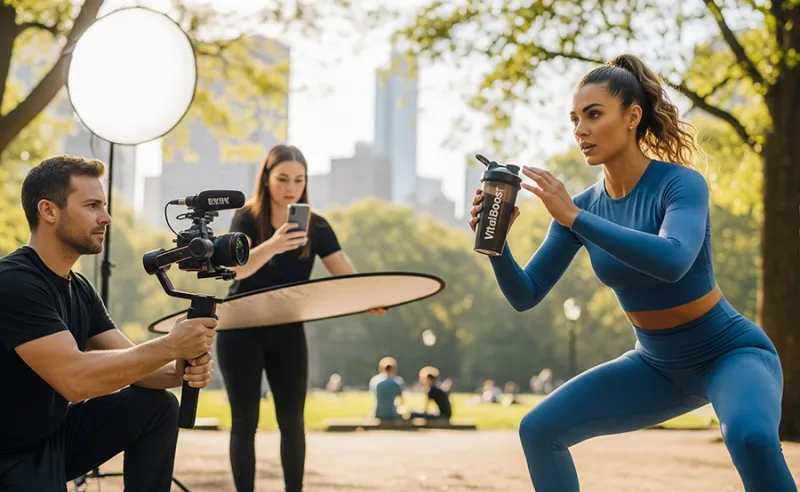
Photo: fitness influencer filming supplement product with phone ring light gym, via nutramarketers.com
Your favorite fitness creator posts a teaser: grainy gym footage, a cryptic logo, "something big is coming." Two weeks later, it's a supplement line — pre-workout, protein, maybe a hydration stick. The launch sells out in hours. The discount code "FLEX15" floods the comments.
None of this is shady by definition. But if you're spending $45 on a tub because you trust a person rather than a product, you deserve to know what that money actually buys. So let's follow it.
The Anatomy of an Influencer Supplement Brand
Here's the part most launches leave out: the vast majority of influencer supplement companies don't manufacture anything. They partner with a contract manufacturer — several large ones in Texas, Utah, and Florida specialize in exactly this — and essentially rent a product off the shelf.
The typical pipeline looks like this:
- The creator (or more often, a brand agency) picks products from a manufacturer's existing catalog. Many manufacturers keep ready-made formulas for pre-workout, whey, and greens powder, waiting for a logo.
- Flavor and color get customized. Maybe a new sweetener ratio, a signature "blue raspberry ice" — cosmetic tweaks, not reformulation.
- Labels get designed, usually emphasizing the influencer's story over ingredient specifics.
- The product drops at a premium price, often 30–60% above comparable products with identical formulas.
This is called white labeling, and it's how a surprising share of the supplement market works — influencer-owned or not. The question isn't whether a product is white-labeled. It's whether you'd buy the underlying formula at its real value.
The Discount Code Economy
Affiliate codes aren't just discounts — they're tracking and revenue-sharing tools. When a creator earns 10–20% commission on every sale, the incentive structure gets interesting. Some creators promote multiple competing brands simultaneously. Some negotiate exclusivity. A few quietly own equity in the brands they push, which disclosure laws say should be tagged with #ad but frequently aren't.
We're not here to say influencers are villains. Many genuinely use the products. But "I take this every morning" and "this formula is worth the price" are two very different claims, and only one of them is about you.
The Five-Point Evaluation Framework
Before you buy anything with a face attached to it, run it through this checklist:
1. Is there a full disclosure label? If the pre-workout hides its doses behind a "proprietary blend," you're paying for marketing, not transparency. Our rule of thumb: if they won't tell you the citrulline dose, assume it's underdosed.
2. Who actually makes it? Sometimes you can find the contract manufacturer on the label's "distributed by" line. A quick search may reveal the same formula sold under other names for less — sometimes dramatically less.
**3. Is it third-party tested — and can you see the results?" NSF Certified for Sport or Informed Choice certification is the gold standard, especially for competitive athletes. A QR code to a batch COA is a good sign. A vague "lab tested" badge with no link is not.
4. Does the formula make sense for the price? Compare the ingredient panel against established products. If a $45 tub contains the same 6g citrulline, 3.2g beta-alanine, and 200mg caffeine as a $30 alternative, the markup is the influencer's margin, not your gain.
5. Is the pitch about the product or the person? "This tastes amazing and I love the brand" is a vibe. "Here's why we dosed L-theanine at 100mg to smooth the caffeine curve" is substance. Reward substance.
When Influencer Brands Are Actually Worth It
To be fair, some creator-led brands have pushed the industry in a good direction. A few have championed fully disclosed labels, published third-party testing, and forced legacy companies to clean up their act. Competition from trusted personalities has, in some cases, lowered prices and raised standards across the board.
The point isn't to avoid influencer supplements forever. It's to buy the formula, not the follower count. If the product would survive on its own merits — transparent label, fair price, real certification — great. If it only makes sense because you feel loyal to the person selling it, close the tab.
Your gym progress doesn't care who signed the label. Check the panel, check the price, and spend accordingly.